
Quick Answer: Moving one heavy item safely comes down to five things: measure the item and the whole path so it fits, clear and pad the route, get gear rated for the weight (an appliance dolly, straps, sliders), use your legs and keep the load close, and bring enough people. Slide when you can, lift only when you must, and hand a piano, a full safe, or a slate pool table to pros.
Most moving-day injuries do not come from carrying a hundred small boxes. They come from one item: the gun safe wedged in a closet, the upright piano against the far wall, the armoire that two people swear they can walk down the stairs. A single heavy object concentrates all the weight, all the awkward balance, and all the risk into one lift, and that is exactly where a back gives out, or a foot gets crushed. The good news is that a heavy item is predictable. It weighs what it weighs, it fits where it fits, and if you plan the move before you touch it, you take most of the danger out of the equation.
Why One Heavy Item Is the Riskiest Part of Any Move
The physics is worth understanding before you lay a hand on the thing. A load is manageable when the weight sits low, stays close to your body, and does not shift while you hold it. A heavy single item breaks all three rules at once. Its center of gravity is often high or off to one side, so it wants to tip. It is too wide to keep close, so your arms lever the weight away from your spine, multiplying the strain. And unlike a box, its weight can move: a safe with a loose shelf, water sloshing in a fish tank, the top of a wardrobe swinging as you angle it through a door.
Think of your lower back as a hinge on a gate. A gate that swings a light garden fence takes the load easily. Hang a solid iron gate on that same hinge and let it swing wide, and the swinging weight tears the hinge off the post. Your spine works the same way. It is not the raw weight that hurts you; it is the weight held far from your body, twisted, or dropped suddenly. Every technique below exists to keep that hinge loaded straight and light.
Step One: Measure the Item and the Whole Path
Before gear, before people, you measure. Not just the item, the path it has to travel.
Record the item's height, width, and depth, then walk the route from where it sits to the truck. Note every door opening, hallway width, ceiling height on a stairwell, and the tight radius of any turn. The failure point is almost never the open floor. It is a corner, a banister, a doorway that is an inch too narrow when the piece is upright. Measuring first tells you whether the item goes straight through, has to be tipped and angled, or has to come apart.
This is also where you decide what to disassemble. Doors that come off a wardrobe, legs that unbolt from a table, a treadmill that folds, glass shelves that lift out: every piece you remove drops the weight and shrinks the footprint. Bag the hardware and tape it to the item so nothing walks off. A piece you can carry as three light parts beats one you wrestle as a single monster.
Step Two: Clear and Protect the Route
Once you know the path, clear it completely. Pick up rugs that slide, coil cords out of the way, prop open every door, and move furniture out of the corners you will need to swing around. A stubbed toe or a snagged foot at the wrong moment is how a controlled move becomes a dropped one.
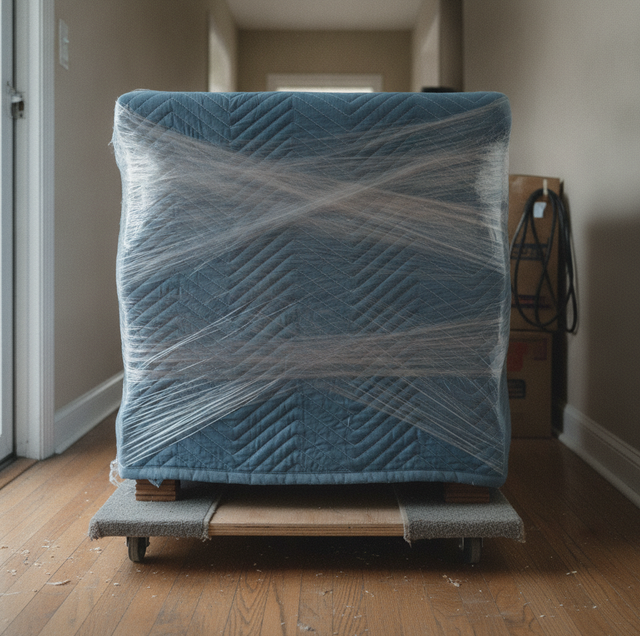
Then protect what stays. Lay moving blankets or a run of hardboard along the floor where the load will travel, especially over hardwood and tile that scuffs or cracks. Pad the corners and door jambs that the item will pass close to. On the item itself, wrap it in moving blankets and hold them with stretch wrap so the surface is covered before it ever moves. Protection is cheaper and faster than repair, and it also gives you grip points and a buffer if the piece bumps a wall.
Step Three: Get Gear Rated for the Weight
The right equipment turns a lift into a roll, and the ratings on that equipment are not decoration. A dolly stamped for a certain load will fail past it, usually at the worst moment.
- Appliance dolly- Taller than a standard dolly, with a strap to lock the item on and rails on the back for climbing stairs one step at a time. This is the tool for a refrigerator, a safe, or a tall cabinet.
- Flat furniture dolly- A low platform on four casters for rolling a heavy piece across level floors. Good for a dresser or a crate, useless on stairs.
- Moving straps- Forearm or shoulder straps that shift part of the load off your hands and onto larger muscle groups, and let two people share a piece evenly.
- Furniture sliders- Hard plastic or padded discs that go under the feet so you push instead of lift on a hard floor or carpet.
- A ramp- Bridges the gap and the lip at the truck, so the dolly rolls up instead of getting hoisted.
Check the weight rating on the dolly and the straps against the item. If you are not sure the item is under the rating, treat it as over.
Step Four: Use Your Legs, Keep It Close, Never Twist
When a real lift is unavoidable, form is everything. Set your feet about shoulder width, squat down by bending your knees and hips rather than rounding your back, and get a firm grip. Drive up through your legs, keeping the load pulled in against your body the whole way. Your spine stays stacked and neutral, not curled over the item.
The move that wrecks backs is the twist. Never rotate your torso while holding a weight. Turn by stepping your feet around instead. And never carry a heavy piece across a room in your arms when you could slide it or roll it: lifting is for getting an item onto a dolly or over a threshold, not for transport.
If more than one person is carrying, one voice calls the move. Agree on the plan, count it down out loud, and lift, step, and set down together. Most dropped-item injuries trace back to two people who moved on different beats.
Step Five: Bring Enough People and Take Stairs Slowly
Enough people means no one is working near their limit. If you are straining just to hold your end level, the item is already short of a person. Spread the weight so every set of hands has a share it can control, and keep a spotter free on any staircase.
Stairs are the sharpest hazard in the whole move, because a slip there adds a fall to the weight. Take them one step at a time with the heavier end downhill and a spotter below to guide and brace, never to catch a falling load with their body. On an appliance dolly, tip the item back to balance over the wheels and let the stair rails walk it down one tread at a time under control. Slow is the goal. There is no version of this that rewards speed.
Know Which Items Are a Pro Job
Some items are not a matter of enough friends and the right dolly. A piano, a full gun safe, and a slate pool table each carry their weight so unevenly that they can shift without warning, and the combination of raw weight, awkward balance, and the damage a slip does to both the item and the person makes them a job for people who move them every week. There is no prize for proving you could do it yourself, and a cracked slate bed or a dropped piano costs far more than the help would have. When an item truly sits in that class, the safe call is to stop and bring in a crew.
Frequently Asked Questions
A common interior door is about 30 inches wide, and a hallway is about 36, so measure the item's smallest cross-section against those two numbers before you commit. A fridge or a safe usually clears a doorway on its side or turned to a corner rather than pushed straight on, which changes which dimension actually has to fit. Once you know the tightest opening on the route, you know whether the piece goes through upright, has to be tilted, or needs a part removed first.
An appliance dolly is rated by capacity, often 600 to 800-plus pounds, and pairs a strap with stair-climber rails so it can hold and walk a tall load down steps. A four-wheel furniture dolly rolls a load flat across a level floor and is rated lower, since it is built to spread weight rather than climb. The real decision is to match the dolly's stamped rating to the item's weight, then let the route settle whether you need the stair rails or just the flat platform.
Felt or hard-plastic furniture sliders cut the drag on a heavy piece dramatically, so sliding takes far less force than carrying and keeps the weight off your spine. Match the slider to the floor: hard plastic sliders glide a load across carpet, while felt pads are the ones for hard floors. Reserve an actual lift for the moments that demand it, getting the item onto a dolly or over a threshold, and slide it for the rest of the trip.
Keep each person's share under about 50 pounds of dead lift, and the head count follows from there: a 300-pound safe wants four people plus a spotter, not two who swear they can manage. An awkward shape counts as extra weight, because a wide or top-heavy piece keeps you from getting close to it and levers the load away from your body. If you are straining to hold your end level, you are already a person short and should stop rather than push through.
An upright piano runs 300 to 500 pounds, and a gun safe often 500 to 1,000, with the weight sitting high and off-center rather than low and even. That tip-over risk on stairs is exactly why these pieces are moved with specialized dollies, ramps, and several trained movers who do it every week. There is no prize for proving you could wrestle one yourself, and a dropped piano or a cracked safe costs far more than the crew would have.
Lay quarter-inch hardboard or ram board over finished floors along the route, not just blankets, because a loaded dolly wheel concentrates enough weight in one small contact point to dent wood or crack tile through a thin blanket alone. Wrap the item itself in moving blankets held snug with stretch wrap so its hardware and edges do not gouge anything they brush. That way, one rigid layer protects the floor from the wheels and a soft layer protects the item from the trip, in a single pass of prep.
Book a crew for the item you should not lift alone — protect your back and your belongings. Timeless Moving LLC serves Katy, Cypress, and Sugar Land. Call (346) 489-5383.
