
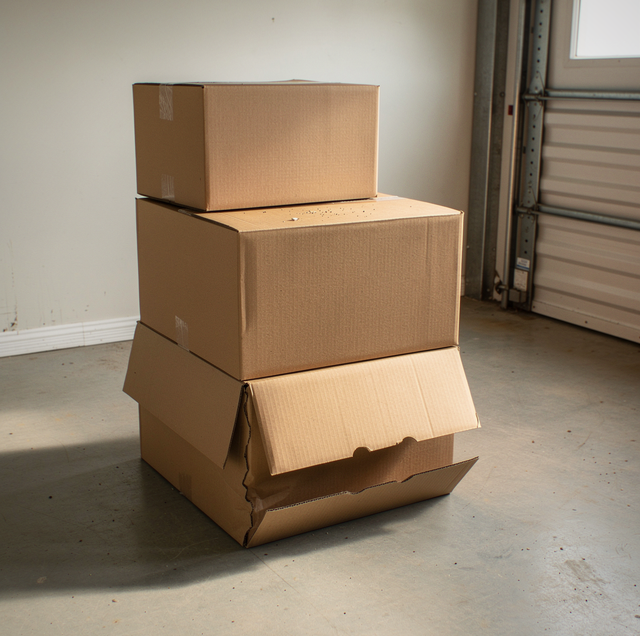
A stack of boxes that stood perfectly straight in a dry garage can slump sideways within a few weeks inside a storage unit, and the boxes themselves haven't changed. What changed is the water vapor in the air around them. Cardboard, paper, wood, and cloth are all what materials scientists call hygroscopic: they pull moisture from the air and hold onto it, and that absorbed water changes how strong, stiff, and stable each material is. Knowing how humidity affects a box and its contents explains why some stacks fail and others don't, and it points to a few decisions about where you store things, what you store them in, and how you stack them.
Cardboard and wood held at near 80 percent relative humidity can develop mold inside a closed box before any staining appears from the outside. Inspect items that sat in humid storage for weeks before bringing them indoors.
Cardboard Loses Strength Long Before It Looks Wet
Corrugated cardboard gets its stacking strength from its layered structure, and that structure is exactly what humidity attacks. A box is built from two flat sheets of linerboard glued to a fluted paper medium between them, and under a stacking load, the ridges of that medium stand as a row of short columns carrying the weight, which works only as long as the fibers holding them remain rigid. Paper fibers are cellulose, bonded to each other by hydrogen bonds that form as the sheet dries during manufacturing, and water molecules from humid air slide between those fibers, loosening that grip. As relative humidity climbs from a dry 30 to 40 percent toward 80 or 90 percent, a standard box can lose roughly half its stacking strength, measured by box compression testing, without a single visible sign of damage. A box can look perfectly square while carrying only a fraction of the weight it was built to hold.
Quick Answer: Keep stored boxes near 50 to 55 percent relative humidity. Corrugated cardboard sheds stacking strength steadily as humidity rises above that, and mold germinates on paper and wood once sustained equilibrium humidity reaches roughly 80 percent.
The Bottom Box Carries the Weight and the Failure
In a five-box column sitting in a humid space for a few weeks, the top box usually still looks fine while the bottom one has bowed inward or buckled at the corners. That's simple compounding: the bottom box supports the combined weight of everything stacked above it, so it carries the most load at the exact moment its own strength has dropped the most. A column that stayed well within a dry box's rating back in a garage can exceed a humidity-weakened box's rating inside a storage unit, with nothing added to the stack. Once the bottom box's walls start to bow, the boxes above settle and lean, and the column loses the vertical alignment that gave it strength.
Corrugated boxes carry stacking weight best when the flutes run vertically, top to bottom, not sideways. Upright flutes typically hold noticeably more weight than the same box turned on its side.
Sealed Plastic Can Trap More Moisture Than It Keeps Out
A sealed plastic tub does not stop humidity problems. It just changes which one you get. Plastic totes don't absorb water the way cardboard does, so their walls stay just as rigid in a humid unit as in a dry one, and that favors plastic. But a tight lid also traps whatever moisture is already inside, whether from slightly damp fabric, a parcel that wasn't fully dry, or ordinary air sealed in when the lid went on. That moisture has nowhere to go without airflow, so it condenses on the coolest surface inside, usually the lid or the wall nearest an exterior surface, and settles onto whatever sits against that spot. Cardboard suffers because it breathes; plastic holds its rigidity because it doesn't breathe at all, and that same lack of airflow is what lets condensation and mold take hold inside a sealed tub in ways a porous cardboard box tends to avoid.
Paper, Fabric, and Wood Absorb the Same Air Differently
Paper, cotton, and solid wood each take on water from the air at their own rate, and each shows the effect in its own way.
Paper products: Documents, books, and photo mattes are almost pure cellulose with a large surface area for their weight, so they absorb and release moisture fast. High humidity makes pages cockle, swell at the edges, and stick together under their own weight.
Natural-fiber textiles: Cotton, wool, and linen absorb far more water by weight than synthetic fabrics like polyester, and a damp natural-fiber item packed tightly against other fabric gives mold both a food source and no airflow to dry out with.
Solid wood furniture: Wood swells across the grain as it absorbs moisture, and glued joints, dovetails, mortise-and-tenon corners, dowelled rails are usually the first place that shows, because a joint traps moisture longer than a flat surface does. A joint that swells tight can shrink loose again once conditions dry, often the real cause of a chair or dresser that develops wobble months after a move.
Electronics, Photographs, and Instruments Have the Least Room for Error
Electronics, photographs, and wooden instruments share a trait that makes them worse candidates for humid storage than almost anything else in a house: their damage often starts on a surface nobody can see from outside.
Electronics: A laptop or television that has spent hours in a cold truck and then moves straight into a warm, humid room can develop condensation on its internal circuit boards because the chassis remains below the dew point of the room's air until it warms up. Moisture on exposed metal contacts causes corrosion and short circuits, which is why electronics moved on a humid day need time at room temperature before anyone plugs them in.
Photographs: Photographic prints carry a gelatin-based emulsion layer that absorbs moisture readily, and in a humid, poorly ventilated box that layer can soften enough for adjacent prints to fuse together at their edges, damage that doesn't reverse once it happens.
Wooden instruments: Guitars, violins, and pianos rely on tightly glued joints and thin wood panels that respond quickly to humidity swings. The same swelling that loosens a dresser joint can pull a soundboard brace loose or keep a case lid from closing flush.
Covered Storage and Climate-Controlled Storage Solve Different Problems
Blocking rain and blocking humidity are not the same job, and a storage space built only for the first one lets the second run wild. A covered unit, whether a standard drive-up unit, a garage, or a steel shipping container, keeps precipitation and direct sun off the boxes inside, but does nothing to control the moisture already in the air, which exchanges with the outside atmosphere whenever a door opens, or a temperature swing pulls air through gaps in the structure. Climate-controlled storage manages both temperature and relative humidity together, holding humidity in a range that keeps paper and wood stable, because the two are linked: warm air holds more water vapor than cool air at the same reading, so a covered space swinging from a hot afternoon to a cool night pushes its air past the dew point and drops condensation onto walls, boxes, and furniture alike, every cycle.
A Humid Day on the Truck Adds Its Own Risk
Loading day doesn't pause for weather, and a truck sitting in full sun for a few hours behaves like a small greenhouse before it ever pulls onto the road. Metal cargo trucks heat up fast, and the boxes loaded first sit through the highest temperatures and the biggest swing between that heat and whatever cooler air moves in once the truck starts moving or the sun goes down. On a humid day that swing matters: warm, moisture-heavy air trapped inside a closed truck cools as evening arrives, hits its dew point, and leaves condensation on the walls and any exposed metal or glass it touches. Boxes loaded wet, from rain during loading or from sitting outside in high humidity beforehand, add more water vapor to that same trapped air, so the truck becomes a slow-drying, poorly ventilated box of its own for however long the load stays inside it.
Load Order and Risers Decide Which Boxes Take the Damage
Concrete slabs draw moisture up from the ground beneath them and pass a share of it into anything sitting flush against the surface, which is part of why the bottom row of a stack is often the most damaged, regardless of what the stack's own weight is doing to it. Setting boxes on a wood pallet, plastic risers, or scrap lumber breaks that contact and lets air move underneath, cutting down both the moisture wicking up from the floor and the humidity trapped against the box's bottom panel. Heavier boxes belong on the bottom regardless, but they should be well-taped and solidly packed rather than loosely filled, since that's what actually carries the combined load and the floor's moisture without failing. Leaving a few inches of air space between the stack and the walls does the same job on the sides that risers do on the bottom.
Frequently Asked Questions
Yes. Double-wall boxes, built with three sheets of linerboard and two fluted layers instead of one, start with roughly twice the stacking strength of a standard single-wall box, so they absorb a bigger humidity-driven loss before real failure becomes likely. Larger corrugation also holds up better than the thinner flutes often used for small-parts packaging because the deeper flute gives the board wall greater thickness and thus more resistance to buckling under load.
A compressor-based dehumidifier pulls humidity down fastest where there's power, but its reservoir needs emptying regularly or a drain line run outside. Without power, a passive desiccant tub using calcium chloride or silica-based crystals can pull noticeable moisture from a small, enclosed space over several weeks, though it does little in a large unit whose door opens often.
Mold can begin forming on damp cardboard or wood within 24 to 48 hours in warm, humid conditions if moisture is already present, but the slow loss of a box's stacking strength from ordinary ambient humidity takes weeks, building as the cardboard cycles through humid and dry stretches rather than from one exposure.
A little, but only for the air trapped inside that specific box. A standard small packet holds only a few grams of desiccant, which does not go far in a corrugated box that is not sealed, and it stops working once its crystals saturate, so a packet pulled from an already-opened shoe box or electronics package is often partly used up before it ever goes into a moving box.
It can be. Metal conducts heat and cools faster after sunset than a wood-framed or block building does, so the air inside swings through its dew point more sharply and more often. The shipping industry has a name for the result: container rain, where condensation forms on the interior ceiling and drips onto the cargo below, in metal containers used for storage just as in ones used for transport.
Not tightly, and not directly against bare wood. Plastic wrap pressed straight against a wood finish can trap the wood's own surface moisture underneath it, and over weeks in storage that trapped moisture can cloud a varnish or lacquer finish into a hazy white blotch furniture restorers call bloom. A breathable moving blanket or pad against the wood, with plastic used only as a loose outer layer, protects against scuffs without sealing moisture against the surface.
Worried about humidity damaging your boxes in storage or in transit? — Get careful local movers and packing help that protects what matters most. Timeless Moving LLC serves Katy, Cypress, and Sugar Land. Call (346) 489-5383.