
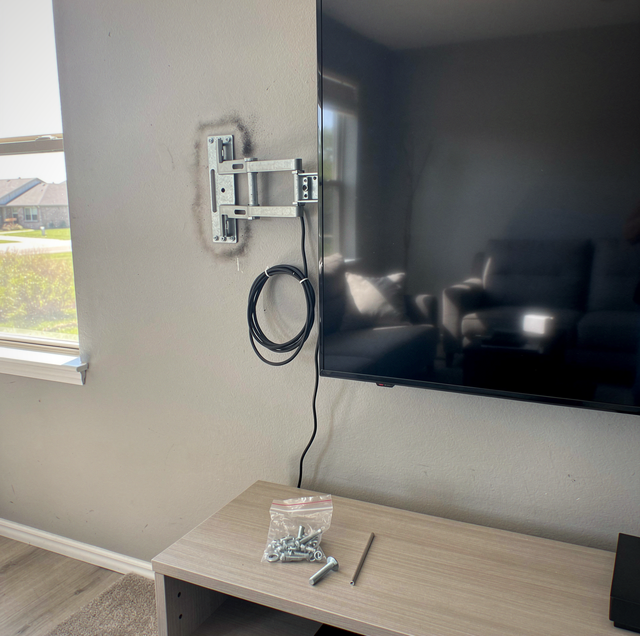
A moving crew can take a wall-mounted TV off its bracket as part of a full house move, lifting the screen free and packing it for the truck, but the wall plate, the mounting hardware, and how the screen goes back up at the new address are three separate calls the owner makes before moving day.
Each part of a wall-mounted TV setup, matched to who handles it on moving day and what the owner tells the crew:
| Part | Who Handles It on Moving Day | What You Tell the Crew |
|---|---|---|
| The screen | Two crew members lift it off the mounting plate and wrap it | That a TV on the wall needs to come down |
| The wall plate and arms of the bracket | Comes down if you want it down, or stays if you want it left | Whether the plate comes off or stays on the wall |
| Mounting bolts and spacers | Bagged with the rest of that TV's hardware | That the bolts and spacers go in one bag with that TV |
| Cables, remotes and small hardware | Unplugged and bundled; nothing electrical is opened | Which remote and cable set belongs to that TV |
| A soundbar or other mounted accessory | Comes down and travels separately if flagged before the lift | Point it out during the walkthrough |
| The holes and anchors left in the wall | Left as they are; not patched or filled | Whether the wall belongs to a rental that needs notice |
Lifting the Screen Off Its Bracket
With the TV unplugged, two crew members lift a wall-mounted screen off its bracket, one supporting the frame from each side, keeping the panel upright the whole time it is in the air, with no weight on the glass face. On a hook-on mount, two rails bolted to the back of the TV hang over the top lip of the wall plate, held down by a locking screw or pull-cord latch at the bottom of each rail; with those latches released, the screen rises clear of the lip and comes away from the wall. Once it is free, the screen is wrapped for the truck with the same protection any electronics get.
A screen lifted off its mount by one person, or from a ladder, can swing free and fall onto someone below. The TV is unplugged before the crew touches the bracket, and children and pets leave the room before the lift.
Taking the Bracket Down or Leaving It on the Wall
The bracket is a separate decision from the screen, and it is the owner's call. Once mounted, a fixed plate holds the screen flush against the wall with no moving parts, so taking it down is a matter of backing out the screws that hold the plate itself. A full-motion arm carries the screen on a hinge that extends and swivels, and each hinge point folds flat before the whole assembly comes off the wall as one piece. A plate left in place holds nothing once the TV is off it; it is just hardware on the wall until someone decides otherwise. Telling the crew which way to go, take the plate down or leave it up, during the pre-move walkthrough is what keeps that decision from being made on the spot.
Keeping Mounting Hardware With the TV
Every bolt, spacer, and lag screw that comes out of the wall or off the back of the panel gets bagged and kept with that TV, using the same bagging-and-labeling approach the crew uses for any piece of furniture that comes apart for the move. A missing spacer can leave the screen sitting crooked on its rails once it goes back up, so the bag travels with the screen.
Cables, In-Wall Power Kits and Devices Behind the Screen
Every cable running into the back of the screen gets unplugged before the mount comes apart: the power cord, the HDMI runs, and any streaming box or game console cabled directly to the TV. A cable still plugged in as the screen rises can pull against its port on the back of the panel. The crew disconnects what is plugged in and coils it loosely for the box. An in-wall power kit stays in the wall: the TV's cord comes out of the kit's recessed outlet, and nothing past that outlet is opened, since the boxes and cable inside the wall are electrical work outside a move. HDMI runs are fed through a pass-through plate beside the kit and remain in the wall as well, with only their ends unplugged.
A streaming stick plugged into the back of the panel comes out with the cables and goes in the TV's hardware bag. A cable box or game console on a shelf below the TV is wrapped and boxed separately, apart from the screen and its bracket.
Mounting at the New Home
Putting the TV back on a wall at the new address is a separate job from the move itself. The crew does not hang a new bracket, drill into a different wall, or promise a same-day remount, so a TV that came off a wall goes into the new home the way any other packed item does: set down in its room. The crew's part ends with getting the boxed screen and its bagged hardware safely into whichever room the owner designates; whoever mounts it next starts from there. Arranging a mount at the destination, whether that means reusing the same bracket, buying a new one, or hiring someone local to install it, is a step the owner lines up separately, on its own schedule.
Some bracket wall plates are fastened to a specific stud spacing, so reusing the same plate at a new house needs a matching stud pattern on the new wall, a detail the installer at the new home checks.
What the Owner Decides Before Moving Day
A few calls belong before the truck shows up. The bracket on or off the wall is the first one, and it depends on whether the place is being sold, handed back to a landlord, or kept in the family. A rental or an HOA property may have its own terms regarding holes and fixtures left behind; those terms come from the lease or the association, and the crew does not decide them on-site. The holes themselves differ by fastener: a lag screw leaves a small hole where it went into a stud, and a toggle anchor leaves a wider one where its wings passed through the drywall. A TV headed into storage needs the same bracket decision made early, since its hardware bag stays with the screen until a mount goes back up. The last piece is which room the TV goes to at the new address, since a box marked with its room goes straight there when the truck is unloaded.
Frequently Asked Questions
The release is the same; the reach is what changes. A mantel keeps anyone at the hearth back from the wall, so the screen is held out at arm's length as it clears the plate, and two people on stable footing, one at each side, share that weight. A single person on a ladder over the hearth cannot hold the panel upright through that reach.
Not always from the outside. A plate lagged into studs and a plate on toggle anchors can look identical once painted over. The difference shows as the screws come out: a lag screw backs out of solid wood, and a toggle's wings are left behind the drywall once its bolt is free.
Yes, if it is pointed out before the lift starts. A soundbar can hang from its own wall bracket, or from an adapter bolted to the TV's mount behind the screen; on an adapter, the bar comes off first, so the screen is lifted without that weight hanging below it.
A plate that will not budge can mean paint sealed over the screw heads, or a plastic anchor spinning in its hole so the screw turns without backing out. Forcing it can tear a chunk of wallboard loose, so a stuck plate can stay on the wall, and whether it comes off later is the owner's decision.
An in-wall kit carries household line power through the wall. A recessed outlet box behind the screen connects by in-wall cable to an inlet box near the floor, and a short jumper cord plugs that inlet into an ordinary wall outlet. A cord running down behind the TV has none of that: it is the TV's own power cord reaching an outlet in the room. For the move, the jumper cord and the TV's cord are unplugged.
Yes, if it still exists. The wall-mounted TV's original feet or pedestal came off when it went up on the wall, and with them back on, the screen can sit on a console at the new address until a mount goes up. The feet can travel packed with the bracket hardware for that TV.
Enlist full-house movers for TV unmounting and wrapping — the screen lifted off its bracket, custom padding for the panel, and labeled boxes for the move. Timeless Moving LLC serves Katy, Cypress, Sugar Land. Call (346) 489-5383.