
How to Load a Moving Truck So Nothing Shifts or Breaks
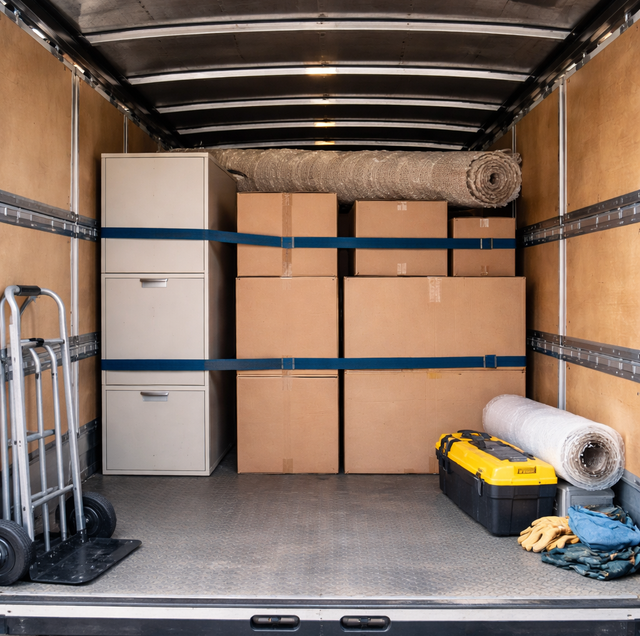
Quick Answer: Load the heaviest items first and toward the front near the cab to keep weight over the axle. Build the load in tiers from floor to ceiling, keep weight low and even side to side, fill every gap so nothing can slide, and strap each tier before adding the next. Save fragile and light boxes for last, on top.
A truck loaded well arrives with the same furniture that left. A truck loaded badly arrives with a cracked dresser mirror, a sofa arm scuffed to the frame, and a box of dishes rattling loose at the back. The difference is rarely luck. It comes down to three things you control: how the weight is spread across the truck, how tightly everything is packed, and how carefully fragile pieces are shielded from the load pressing on them.
The cargo area is a wall you are building, not a bin you are filling. A bin gets whatever fits wherever it lands. A wall gets built in courses, from the bottom up and the front to the back, with each row locked against the one before it. When the truck brakes, corners, or hits a pothole, a wall of cargo holds together. A loose pile shifts, and shifting is what cracks, crushes, and topples your belongings.
Why Weight Distribution Comes First
A loaded truck handles differently than an empty one, and where the weight sits changes how it drives. Put the heaviest items over the front axle, near the cab, and the truck stays balanced and predictable. Pile the heavy pieces at the rear and the back end sags, the steering goes light, and the load swings on turns.
Side to side matters just as much. If one wall carries all the appliances and the other holds only pillows, the truck leans. Balance heavy items left and right as you go, and keep the weight low. A dense stack with the heavy pieces on the bottom is stable. Heavy items riding high are the ones that topple.
Do not chase balance by overloading. Every truck has a weight rating, and exceeding it strains the brakes and tires and makes the vehicle much harder to stop. If the truck feels sluggish or the rear rides low, you have either too much weight or too much of it in the wrong place. Redistribute before you drive.
Load in Tiers, Heaviest First and Forward
The method is simple to say and worth doing in order. You build the load in vertical tiers, working from the front wall toward the door, and within each tier you place the heaviest, most solid items first.
Start with the appliances and biggest furniture: Refrigerators, washers, dryers, dressers, and sofas go against the front wall first. These flat, heavy, rectangular pieces form the foundation the rest of the load leans on. Stand the sofa on end if it fits, which frees floor space and puts a tall flat surface along one wall.
Build each tier floor to ceiling before moving back: Once the front wall is packed, fill the space above and beside those pieces before starting a new tier toward the door. A full, tight tier cannot shift. A half-built one leaves room for everything to slide forward when you brake.
Keep the heavy pieces low: Within any tier, the dense items sit on the floor and lighter items stack above them. This keeps the center of gravity down and stops a heavy piece from crushing something softer beneath it.
Use the walls and disassemble what you can: The truck walls are load-bearing surfaces, not just boundaries. Long, flat items belong against them. Take apart what comes apart: unbolt bed frames, remove table legs, and detach headboards. A disassembled bed frame lies flat against a wall and takes a fraction of the space an assembled one demands. Keep the bolts in a labeled bag taped to the piece, so reassembly is not a scavenger hunt.
Stand mattresses on their long edge against a wall, and do the same with box springs, tabletops, mirrors, and headboards. Vertical items brace the load and stay flat, where a mattress laid across a stack sags and slides. Slip a moving blanket or a mattress bag over each one so it does not pick up grease or scuffs.
Fill the Gaps So Nothing Can Slide
A load fails at its empty spaces. Any gap gives a piece room to build momentum and slam into its neighbor on the next hard stop. After each tier, look across it and find the holes.
Soft goods are your filler. Bags of linens, pillows, and cushions wedge into the spaces between hard furniture and hold everything in place. Boxes fill the larger voids. Slide smaller boxes into the pockets between and above furniture so the whole tier becomes one packed mass with nothing free to travel.
Padding does double duty. A rolled blanket tucked between a dresser and the wall fills the gap and cushions the finish. The goal for every tier is the same: press on it and nothing rocks, leans, or has anywhere to go.
Strap off each tier before the next: Most rental trucks have logistics tracks running along the walls with slots for tie-down straps. Use them. Run a strap across the face of each completed tier and cinch it to the tracks so that row is anchored before you build the next one against it. If the truck has no tracks, rope tied to the anchor points does the same job.
Strapping as you go beats one big strap at the end. A tier held back by its own strap cannot lurch forward into the next section, and it keeps tall items like a standing sofa or mattress from tipping into the aisle. By the time you reach the door, the load is a series of strapped, self-supporting sections rather than one tall stack hoping to stay upright.
Load Boxes to Protect What Is Inside
Boxes follow the same logic as furniture: heavy on the bottom, light on top. A box of books or dishes at the base of a stack anchors it. The same box on top crushes whatever it lands on and makes the stack top-heavy.
Pack the boxes so they hold their shape. A box filled to the top with flat flaps can bear weight above it. A half-empty box caves in and buckles the stack. Fill light spaces inside with paper or soft goods so the walls stay square.
Fragile boxes come last and ride on top, never under anything. Dishes, glassware, electronics, and lamps go above the heavy stacks where nothing presses down on them. Label them on the top and sides so no one sets a toolbox on the box of stemware. Inside a fragile box, plates stand on edge rather than lying flat, which lets them share pressure instead of stacking it onto the bottom plate.
Wrap furniture before it touches anything: Bare furniture rubbing against straps, walls, or other pieces is how finishes get scratched, and corners get chipped. Cover it before it goes in. Moving blankets go over dressers, tables, and wood surfaces, held on with stretch wrap so they do not slide off. Stretch wrap alone keeps drawers and cabinet doors from swinging open and holds cushions to a sofa.
Wrap the pieces that carry weight or lean against others most carefully, since those contact points take the abuse over a long drive. Corners, legs, and glass fronts deserve an extra layer. A few minutes of wrapping at the curb prevents the damage you would otherwise find at the far end.
Keep an Essentials Zone and Secure the Load
Load the things you will want first at the destination so they come off last. Box up essentials, tools, chargers, and anything for the first night, and set that section right by the door. Keep a clear path down the middle so you never climb over a stack to reach the back.
Before you close the door, do a final check. Every tier strapped, nothing loose or leaning, fragile boxes on top and marked, and the load balanced front to back and side to side. Push on the outermost tier. If it holds, you are ready. If it rocks, add a strap or a filler box before you go. A load that cannot shift in the truck cannot shift into the person who opens the door at the other end.
Lift Without Hurting Yourself or Overloading the Truck
The heaviest items put your back and hands at risk, and rushing them is how injuries happen. Appliances and full dressers are team lifts. Two people moving one piece with a plan beats one person straining alone.
Use a dolly for anything you would struggle to carry: An appliance dolly with a strap takes the weight off your back and rolls a refrigerator or a stack of boxes up the ramp under control. Secure the item to the dolly before you tilt it.
Lift with your legs, not your back: Squat, keep the load close to your body, and stand up with your legs. Keep your back straight and turn with your feet rather than twisting your spine under a load. A dropped or mishandled heavy item can crush a hand or foot, so keep clear feet and a clear path.
Respect the ramp: A truck ramp is a slip and fall hazard, especially when it is wet or gritty. Keep it clear of loose items, wipe it dry if it is slick, and take one piece at a time rather than crowding two people onto it at once.
Appliances and full dressers are team lifts. Lift with your legs, keep the load close to your body, and turn with your feet rather than twisting your spine, since a dropped or mishandled heavy item can crush a hand or foot. Keep the ramp clear and dry, since it is a slip and fall hazard when wet or gritty.
And keep the truck within its limits. Do not load past its weight rating to save a trip, and never stack cargo so high or so far forward that it blocks the driver's view through the mirrors and rear window. A truck you cannot see out of or stop cleanly is more dangerous than a second trip.
Frequently Asked Questions
The order is the same, but a longer drive raises the stakes on strapping and gap-filling. On a short hop across town, a slightly loose stack might survive a few turns. Over hundreds of miles with highway speeds and repeated braking, every small gap adds up to movement that works items loose. For any drive longer than a few minutes, strap every tier and fill every void as though the load has to hold for hours, because it does.
Beyond placing it forward and low with the heavy appliances, secure the drum first. Front-load washers should have shipping bolts reinstalled to lock the drum, since a loose drum bouncing over road bumps can damage the suspension inside. If the bolts are gone, pad the drum with towels and move the machine gently. Tape the door and hoses so nothing swings, and stand the machine upright, not on its side.
They solve different problems. Moving blankets are thick pads that cushion against impact and abrasion, protecting finishes and corners from knocks. Stretch wrap is a thin clingy film that holds things in place: it keeps drawers shut, binds a blanket to a dresser, and bundles loose parts. Blankets without wrap slide off in transit; wrap without a blanket offers little cushioning. Used together, the blanket protects, and the wrap holds it where you want it.
Lightweight, soft contents like folded clothes can usually stay, and they add useful padding. The catch is weight. A dresser heavy with full drawers can exceed a safe team lift and strain its own joints when tilted onto a dolly. Empty the drawers of anything dense such as jewelry boxes, books, or tools, then wrap the whole dresser so the drawers cannot slide open on the ramp.
Leave enough to close and latch the door without forcing it against the load, but no more. Excess empty space at the back lets the whole load shift rearward on the first hard stop, the exact movement strapping is meant to prevent. If a gap is unavoidable, brace the last tier with a strap across the door track or wedge soft-goods bags into the space so the load stays put.
Anything hollow, fragile, or unable to bear weight: boxes of glassware or dishes, lamps, electronics, framed art, and light half-full boxes. Bottom positions carry the compression of everything above, so reserve them for dense, solid items that hold their shape, like books, tools, and full, well-packed boxes. Mark fragile boxes on the top and sides so they never get buried during a fast load-in.
Book a crew that loads your truck to arrive intact — careful handling from start to finish. Timeless Moving serves Katy, Cypress, and West Houston. Call (346) 489-5383.
