
How to Move Fragile Items Without Damage: 9 Packing Steps
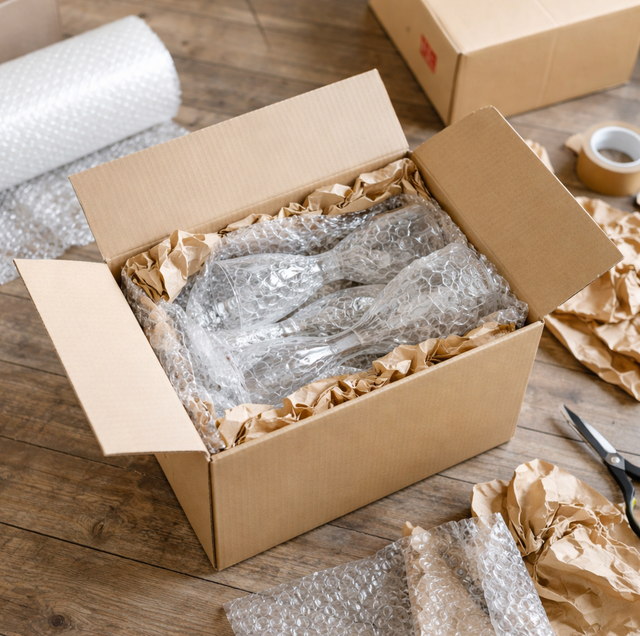
Quick Answer: Wrap each item individually, stand plates on edge, seat glasses in a divided box, and fill every gap so nothing shifts. Cushion the bottom and top of each box, keep fragile boxes light enough to lift easily, and label them FRAGILE and THIS SIDE UP. Load them last and on top in the truck.
Fragile items rarely break because someone was careless. They break for three reasons: impact when a box is dropped or set down hard, pressure when heavier things press down on lighter ones, and shifting when contents slide around inside a loosely packed box on a moving truck. Every packing decision below exists to defeat one of those three forces. The goal is simple to state and easy to get wrong: cushion each piece, immobilize it so it cannot move, and label the box so it gets handled and stacked correctly.
A well-packed fragile box behaves like a helmet. The hard shell (the box) takes the hit, and the padding inside (paper, bubble, foam) spreads the force out so no single point on the object absorbs it. A helmet with a loose fit does almost nothing, and a box with gaps inside does almost nothing either. Fill the space, and you change the physics.
Start With the Right Boxes and Supplies
The container matters as much as the wrapping. A sturdy small box is your default for anything heavy-for-its-size like dishes, books, or glass, because a small box stays liftable and resists crushing better than a large one packed to the same weight.
The supplies worth having on hand
- Dish-pack (dish barrel) boxes: These are double-walled cartons built for kitchenware. The extra corrugation resists crushing far better than a standard box.
- Cell kits and dividers: Cardboard grids that create individual compartments so glasses and stemware never touch.
- Packing paper: Clean newsprint (unprinted) is best. Regular newspaper works but the ink transfers onto china and glass.
- Bubble wrap: For contoured or very fragile pieces. Small-bubble for delicate surfaces, large-bubble for shock absorption on bigger items.
- Foam corners and foam pouches: Foam corners protect the vulnerable edges of framed art and electronics. Pouches slip over glasses fast.
- Sturdy tape and a marker: Reinforce every seam of the box, top and bottom, and keep the marker handy for labeling.
Old towels, dish cloths, and clothing can supplement paper and bubble in a pinch, though they compress and shift more, so keep them for filling voids rather than for the first wrap around a piece.
Wrap Every Piece Individually
The single habit that prevents the most breakage: nothing goes in a box bare, and no two hard items touch. Lay a sheet of packing paper flat, set the item near one corner, and roll it up, folding the sides in as you go so the whole surface is covered. For anything with a handle, spout, or thin rim, add an extra wrap around that weak point.
Bubble wrap goes bubble-side-in against delicate finishes so the flat side faces out and the bubbles cradle the surface. Secure each wrap with a small piece of tape, but never tape directly onto a painted, lacquered, or gilded surface, as the adhesive can lift the finish.
Once the wrapped pieces are in the box, press crumpled paper into every gap and give the box a gentle shake. If you hear or feel anything move, add more fill, since a box that stays silent when shaken will not shift on the truck.
Pack Plates, Bowls, and Glassware the Right Way
Different shapes fail in different ways, so they get packed differently.
Plates go vertical, on edge, not stacked flat: A plate lying flat under weight cracks across the middle, but a plate standing on its edge is far stronger, the same way a sheet of paper stands up when curled. Wrap each plate, then stand them on edge in a row inside a dish-pack box, packed snugly with a thick paper cushion below and above.
Bowls nest with padding between them: Wrap each bowl, then stack same-size bowls with a folded sheet of paper between each, and set the stack in the box on its side or upright depending on which keeps it snug.
Glasses and stemware go in cells: A divided cell kit gives each glass its own compartment. Wrap the glass, or slip it into a foam pouch, then stand it in a cell. Stuff paper inside each glass first to support the walls from within. Stemware is fragile at the stem, so wrap the stem separately and orient the glass upright in a tall cell.
Double-Box the Most Fragile Pieces
For a treasured vase, a piece of fine china, or anything irreplaceable, one box is not enough. Wrap the item, cushion it inside a small box, then set that box inside a larger one with two to three inches of packing material on every side. The outer box absorbs the impact, and the inner box never feels the full blow. This is standard practice for items with sentimental or high monetary value where a single layer leaves too little margin.
Cushion the Bottom and Top of Every Box
Even a perfectly wrapped set of dishes needs a shock layer at the two points most likely to take a hit: the base, where the box lands when set down, and the top, where something might get stacked.
Build the box in layers
- Lay two to three inches of crumpled paper or a bubble sheet across the bottom.
- Place the heaviest wrapped items on the bottom, lighter ones toward the top.
- Fill all side gaps as you go so nothing leans or slides.
- Add a final two-inch cushion of paper across the top before closing.
- Close the flaps. They should meet without bulging and without caving in. A lid that bows inward means the box is underfilled, and a lid that will not close means it is overpacked.
Keep Fragile Boxes Light and Clearly Labeled
A crushing load from above is one of the top causes of breakage, and it starts with a box that is too heavy to handle. Keep every fragile box light enough to lift and carry comfortably, so it is easy to control and easy to set down gently. Heavy fragile pieces such as a marble tabletop, a large mirror, or a big monitor are a team lift, moved by two people, never wrestled solo.
Label the top and at least two sides of every fragile box: FRAGILE and THIS SIDE UP, plus a note of the contents and the room it belongs in. A box marked only on the top gets read only when it is already flat on the floor. Marking the sides means whoever picks it up knows before they lift.
Handle Electronics, Mirrors, and Art Separately
These items have their own rules.
Electronics travel best in their original boxes with the molded foam inserts, if you saved them. Without the originals, wrap the unit in an anti-static material rather than plain bubble wrap, since ordinary plastic can build a static charge that harms sensitive components. Photograph the cable connections before unplugging, so reassembly is quick, and coil cords loosely rather than kinking them.
Mirrors and framed art go in telescoping mirror boxes. Before boxing, run a large X of painters' tape across the glass face. The tape will not stop a break, but it holds the glass together if it does crack, which contains the sharp shards. Protect the corners with foam corners, then slide the piece into the mirror box standing on edge, and mark clearly which way is up.
Know When a Crate or Professional Packing Is Worth It
Some pieces exceed what a cardboard box can safely handle: a large glass tabletop, a stone or marble surface, a chandelier, fine art, or an heirloom that cannot be replaced at any price. For these, a custom wooden crate built to the object's dimensions gives rigid, all-around protection that no box can match.
Professional packing earns its place when the item is high-value, awkwardly shaped, or heavy enough that a slip becomes a safety issue as much as a breakage one.
Broken glass is a real laceration hazard, and a heavy fragile piece such as a marble tabletop, a large mirror, or a big monitor can shift mid-lift and injure the person carrying it. Move these as a two-person team, or have a trained crew crate and load them.
Load Fragile Boxes Last and On Top
All the careful packing in the world fails if a fragile box ends up on the bottom of a truck stack under heavy furniture. Fragile boxes load last and ride on top of heavier, sturdier cargo, wedged so they cannot slide during transit. Keep them out of the crush zone, secure the load so nothing tips into them, and carry them into the new home yourself rather than adding them to a dolly stack.
A quick note on temperature: a truck interior can swing hot in warmer months and cold in cooler ones, and both extremes affect sensitive items. Candles and vinyl records soften and warp in heat, while some electronics and liquids react badly to freezing. Plan to move heat- and cold-sensitive fragiles in the passenger cabin when the weather runs to either extreme, whatever the season.
Frequently Asked Questions
Soft goods work as void fill and as a secondary cushion, but they should not be the first layer against a hard, delicate surface. Fabric compresses under pressure and can let two items touch, and any grit trapped in a towel can scratch glass or a lacquered finish. Use a clean sheet of paper or a foam pouch as the first wrap, then pack towels around the outside to fill gaps. Microfiber cloths are the safest fabric choice because they hold less grit.
Use a specialty flat-panel TV box, which telescopes to fit and holds the screen upright on its edge, since flat-panels are weakest when laid flat and pressed from above. Cover the screen with a soft blanket or foam sheet first; never bubble wrap directly against the panel, because the bubble texture can leave pressure marks on some display coatings. Stand the TV vertically in the truck between two padded, immovable surfaces so it cannot tip face-forward.
Sheathe each blade in a knife guard or a folded strip of stiff cardboard taped closed, then wrap the whole thing in paper and label the bundle "SHARP." This protects both the edge from chipping and your hands from a laceration when the box is opened. Keep sharp items in a separate small box rather than mixed with glassware, so no one reaching for a wrapped glass meets an exposed edge.
Yes. Remove loose and AA/AAA-style batteries from remotes, clocks, and portable devices, because a battery jostled during transit can shift, short, or leak corrosive fluid onto the contacts. Tape over the battery compartment door so it does not spring open. For devices with sealed internal batteries, that step does not apply, but still power them fully off rather than leaving them in standby.
Pack fragiles early, not on moving day, so you are working calmly rather than rushing. A good sequence is to box rarely-used china, decor, and spare glassware a week or two ahead, leaving only daily-use dishes for last. Rushed packing is when gaps get left, and boxes get overloaded, the two mistakes that cause the most breakage, so building in time is itself a protection.
Move it out of the wet immediately and check the bottom seam first, since a damp corrugated box loses much of its strength there and can fail when lifted. If the cardboard is soft or sagging, repack the contents into a dry box rather than trusting the weakened one. Slip large trash bags over fragile boxes as a rain cover when carrying them out in damp weather, and set them on a tarp rather than wet ground.
Booking a move with fragile pieces? Let a trained crew pack and load them right. Timeless Moving LLC serves Katy, Cypress, Sugar Land. Call (346) 489-5383.
