
How to Prepare Appliances for Moving: 6 Steps That Prevent Damage
Quick Answer: Prepare appliances by unplugging and shutting off water or gas at least a day ahead, emptying and drying the interior, and securing all doors and moving parts. A gas dryer or range must be disconnected and the gas line capped by a qualified professional, never a homeowner.
Large appliances are the most deceptive items in any move. They look solid enough to shove onto a truck as-is, but each one hides water, gas, or a spinning mass that only behaves while the machine sits level and plugged in. Tilt it, jostle it over a curb, or leave a hose full, and the trouble starts inside the walls of the appliance where you cannot see it until the new house.
Preparing them is less about muscle and more about sequence. Every major appliance follows the same four moves in the same order: disconnect the power and utilities, drain the water, dry the interior, then secure the doors and moving parts. Skip a step, and you invite one of three failures. Trapped water leaks into cardboard boxes stacked around it or freezes and cracks a valve. A gas line left connected can loosen and seep. An unsecured drum, door, or shelf slams around and breaks the machine or the person carrying it.
Why Appliance Prep Is Worth the Extra Day
An appliance is a sealed system built to stay in one spot. A refrigerator's compressor holds oil that needs to settle. A washer's drum floats on springs meant to absorb spin, not highway bumps. A dishwasher's pump keeps a small pool of water at the bottom by design. None of that is a problem in the laundry room. All of it becomes a problem the moment the machine leaves level ground.
Water is the quiet culprit. A supply hose or drain line that looks empty usually holds a cup or two, and that water goes wherever gravity takes it once the appliance is tipped onto a dolly. Gas is the serious one. A gas dryer or range connects to a live fuel line, and disturbing that connection without capping it correctly is a job for a licensed technician, not a weekend project. Weight is the obvious one that still surprises people: a full-size refrigerator can top 300 pounds, and its center of gravity shifts when the doors swing.
The extra day pays for itself. Defrosting, draining, and drying all take time the machine has to spend sitting still. Trying to compress that into moving morning is how interiors end up wet, and doors end up taped over standing water.
Refrigerator: Empty, Defrost, Dry, Secure
The fridge needs the longest lead time of any appliance, so start it first.
Empty and unplug 24 hours ahead: Clear out all food and remove loose shelves, drawers, and the ice bin. Unplug the unit and, if it has a water line for the ice maker or door dispenser, shut that line off at the wall valve and disconnect it. Let any water in the line drain into a shallow pan.
Defrost for a full 24 hours: Frost in the freezer and coils melt slowly. Leaving the doors open overnight lets that meltwater run out gradually instead of pooling in transit. Lay towels along the base to catch runoff, and check them the next morning.
Dry the interior completely: Wipe every surface, including the door gaskets and the drip channels at the back of the freezer floor. A closed, damp refrigerator grows mildew within a day or two in a warm truck, and the smell can outlast the move by weeks.
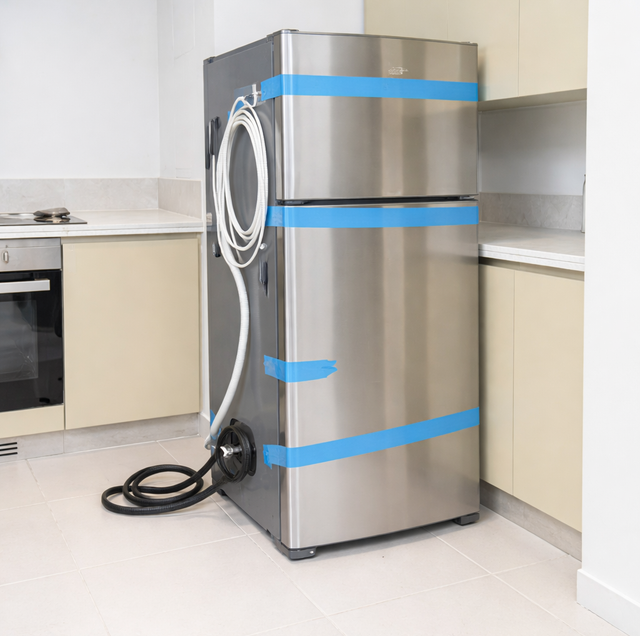
Coil up the line and secure the doors: Coil the disconnected water line and tape it to the back so it cannot snag. Then tape the doors closed with a strip of painter's tape, but leave them cracked open a half inch rather than sealed tight, which keeps air moving and prevents that closed-box mildew.
Washing Machine: Hoses, Drain, and Transit Bolts
The washer carries the highest risk of hidden damage because its drum is deliberately loose inside the cabinet.
Disconnect the hoses: Shut off the hot and cold supply valves, then unscrew both supply hoses. Water will spill from the hose ends and the valve threads, so keep a bucket and towels ready. Unclip the drain hose from the standpipe last.
Drain the residual water: Run the machine's drain or spin cycle briefly before you pull the hoses, or tip the unit gently toward a pan afterward to clear what sits in the pump and the bottom of the tub. A washer that feels empty can still release a quart onto a truck floor.
Install the shipping bolts to lock the drum: This is the step most people miss. A washer ships from the factory with transit bolts, sometimes called shipping bolts, that thread through the rear panel to lock the suspended drum in place.
Reinstall the washer's transit bolts before the move. They thread through the rear panel to lock the suspended drum so it cannot swing and hammer its own springs and shock absorbers on the road. If the original bolts are gone, a universal transit-bolt kit or a fitted brace does the job.
Dryer: Disconnect, and Call a Pro for Gas
The dryer prep depends entirely on whether it runs on electricity or gas.
Electric dryer: Unplug it, disconnect the vent duct from the back, and clean the lint from both the trap and the duct opening. Coil the power cord and tape it to the cabinet so it does not drag.
Gas dryer: A plumber or licensed gas technician closes the valve, disconnects the line, and caps it so nothing seeps during the move.
A gas dryer or range connects to a live gas line, and that connection must be shut off and capped by a qualified professional, never a homeowner. Do not attempt it yourself, and do not let the appliance travel with an open, uncapped gas fitting. The same rule holds for a gas range: shut off and cap at the source, done by someone qualified.
Dishwasher and Range: Shut Off Water and Gas
These two are built into the kitchen, so disconnection is more involved and often worth leaving to the movers or a technician.
Dishwasher: Turn off its water supply, disconnect the supply line and the drain hose, and let both drain into a pan. Run a short empty cycle beforehand if you can, then sponge out the water that always sits in the basin at the bottom. Secure the door and coil the lines.
Range: An electric range unplugs and needs only its door and any loose grates secured. A gas range, like the gas dryer, needs its gas line shut off and capped by a qualified professional before it moves. Cap the grates and knobs separately so they cannot rattle loose.
Secure Every Cord, Hose, and Loose Part
Once each appliance is disconnected and dry, deal with the small pieces that turn into projectiles or lost items.
Coil each power cord and tape it flat against the cabinet rather than letting it dangle where a wheel or foot can catch it. Bag the small parts, the shelves, drawers, ice bins, racks, grates, hose fittings, and transit-bolt hardware, and label each bag with the appliance it belongs to. Tape that bag to the machine so it arrives together. Wrap glass shelves separately in a moving blanket; they crack far more easily out of the fridge than in it.
For the lift itself, treat every major appliance as a two-person job at minimum. Strap the unit upright to an appliance dolly, keep it as vertical as the doorways allow, and let it rest and settle for several hours after placement before you plug it back in, which gives compressor oil and suspension time to return to position. Rushing a refrigerator back on within minutes of setting it down is a common way to strain the compressor.
Frequently Asked Questions
Let it sit upright for the same amount of time it spent lying down, and at least four hours if it traveled standing. When a fridge tips past 45 degrees, compressor oil migrates into the cooling lines, and plugging it in before that oil drains back can burn out the compressor. If the unit ever rode on its side, give it a full day upright before restarting.
You can, but not safely without a substitute. Universal transit-bolt kits are sold for most top and front loaders, and a mover can also wedge foam blocks or a fitted brace between the drum and the cabinet as a stopgap. What you should not do is move it with a fully free-floating drum, which lets the suspension rods punch through their mounts on a bumpy road.
Leave the filter installed, but relieve the pressure first. After you shut off the supply valve, press the water dispenser for a few seconds to bleed the residual pressure out of the internal line, which stops it from dripping inside the door during transit. A twist-out filter can also weep at its housing if the line stays pressurized.
Even a cupful left in a hose can slosh out and soak a mattress or cardboard packed nearby, and on a cold-weather leg it can freeze and expand about nine percent, enough to split a plastic fitting or crack a pump housing overnight in an unheated truck. Blowing the lines clear with a few short bursts of air from a compressor, or draining them fully and tipping the machine, removes both risks in any season.
Earlier, and empty it fully first, because a chest freezer holds cold far longer than a fridge and its thick frost takes 24 to 48 hours to melt clear. A useful trick is placing a coin on a cup of frozen water inside; if the coin has sunk to the bottom by moving day, the contents thawed and refroze, telling you the unit lost power longer than it should have.
Measure the appliance's depth against the narrowest doorway before you lift, and pop off the fridge or freezer doors if the gap is tight, since a door adds several inches. Slide flattened cardboard or floor runners along the path, and pad the door jambs with towels at the exact height of the appliance's widest point, which is usually the handle or a protruding hinge.
Book a crew that handles the disconnect, dolly, and reconnect for you — so nothing leaks, tips, or breaks in transit. Timeless Moving LLC serves Katy, Cypress, and Sugar Land. Call (346) 489-5383.
