
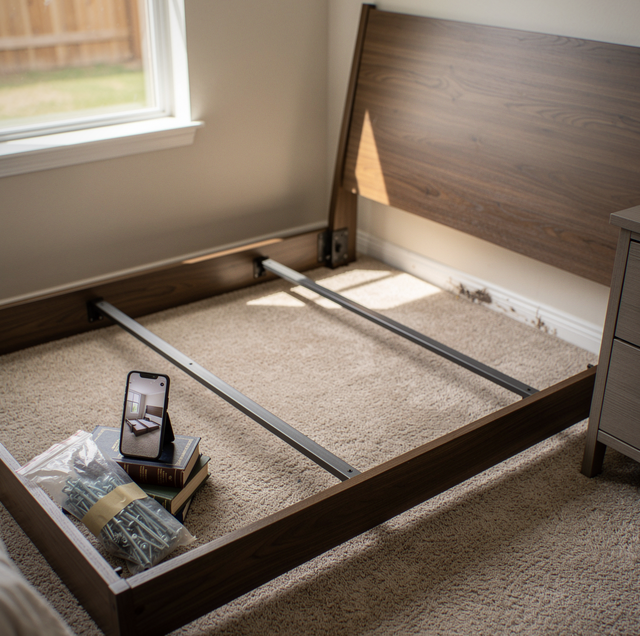
Some furniture cannot survive a move fully assembled. A queen bed frame is too wide for a narrow stairwell with the rails still attached; a dining table on its legs puts strain on its legs; and a sectional can be too long and deep to clear a doorway as a single unit. Deciding what has to come apart, and getting the hardware and photos organized before a single screw comes out, is what keeps disassembly from turning into a pile of parts nobody can identify at the new place. For each common piece, the parts that come off and the parts that travel joined:
| Piece | What Comes Off | What Stays Together |
|---|---|---|
| Bed frame | Headboard, footboard, side rails, and center support | Slats or a slat roll lift out and travel flat; each board and rail stays whole |
| Dining table | Legs unbolt from the apron | The tabletop and apron stay one piece |
| Sectional | Sections separate at the connector clips | Each seat-and-arm section stays whole |
| Desk | Legs or a leg frame detach; a hutch or keyboard tray lifts free | The desktop and any built-in drawer unit stay one piece |
| Crib | Side rails and end panels unbolt into flat panels | Fixed teething rails stay attached to their panel |
| Flat-pack furniture | Comes apart along the same fasteners it was built with | Any glued joint stays whole; it was never meant to separate |
| Wall-mounted shelving | The bracket comes off the wall | The shelf, and any bracket fixed to the shelf itself, stay joined |
Deciding What Comes Apart
The first questions are whether it will clear every doorway, stairwell turn, and hallway corner assembled, and whether carrying it whole puts weight on a joint that was not built to carry it. A table leg joint is built to hold a stationary top, not to carry it. A dresser or bookcase with no protruding legs has no equivalent joint at risk, so taking it apart for joint stress only adds a reassembly step; weight is the separate reason it might still come apart. Disassemble what will not fit through an opening or whose joints cannot carry the load in transit, and leave everything else whole.
Weight is the third trigger, separate from geometry and joint stress. A wardrobe or a wall unit can clear every doorway assembled and still need to come apart simply because two people cannot safely carry the whole mass through a hallway or up a stairwell. Splitting it into a case, shelves, and a base turns one unmanageable lift into several manageable ones, which is a decision about the carry itself rather than about width or a fragile joint.
Photographing and Labeling
Before a single screw comes out, take a few photographs: the piece assembled from the front, and a close-up of each joint or bracket where a connection is about to be broken. A photo of a bracket in place settles what memory cannot, especially days later at the new address. On anything with more than one identical connection point, such as the four-leg brackets on a table, mark each bracket and the matching leg's bare end grain or bolt with a letter on a strip of painter's tape, since legs that look interchangeable can be slightly different in length or angle once installed. A leg swapped to the wrong corner can rock a table that was level before it came apart.
Photograph each hardware bag beside the joint it came from before sealing it, so the bag, its screws and their hole all appear in one picture; at reassembly that single photo settles which screws go where without guessing.
Bagging Hardware with the Piece It Belongs To
Every bolt, cam lock, dowel, and bracket screw belongs in its own sealed bag, sorted by the piece and the joint it came from rather than dumped into one bag for the whole move. Keep the bag with its piece rather than loose in a box. A single missing cam lock or dowel pin can leave an entire joint loose even when every other part of the connection is present, so treat the smallest fastener as carrying the same weight as the panel it holds together.
Keep different fastener types separate in a bag rather than mixing them loose, since a cam lock, a dowel, and a bracket screw for the same piece can look similar in a pile but belong in different holes. A small extra pouch for anything spare, a leftover washer or a duplicate screw that came with the piece originally, saves a search through every bag when reassembly turns up a part with nowhere obvious to go.
Emptying Drawers and Removing Glass Shelves
Empty every drawer before a dresser, nightstand, or file cabinet gets tilted onto a dolly. A loaded drawer shifts that weight forward inside its own frame the moment the piece leans back, and that shift can pull a drawer glide loose from its track or rack a drawer face out of square. Glass shelves inside a bookcase, curio cabinet, or entertainment center lift out and travel on their own rather than staying in their brackets, since a shelf with nothing holding it to the frame can slide free the moment the piece tips even slightly.
A glass tabletop or heavy stone-top piece can crack, shatter, or pin a finger if it tips during disassembly. Leave that piece for the crew to handle as a two-person lift rather than working it loose alone.
What the Crew Does on Moving Day
Disassembly and reassembly on the far end are part of the move itself, not an extra line item, and the crew makes the call on which pieces come apart during the initial walkthrough rather than guessing on the spot. Once a piece is broken down, the crew documents how it was configured, so a bed with a center support bar or a table with an unusual leg pattern gets rebuilt the same way it left the old house. Hardware gets bagged and tagged to its piece, and at the new place, reassembly happens before the crew leaves rather than being left for later.
That same walkthrough is also where a piece with a bracket already coming off the wall, such as a floating shelf or a mounted headboard, gets flagged for the movers' side of the job: taking the bracket down and packing the shelf, not patching or repainting the wall it came off of, which stays a separate task for the homeowner.
Flat-Pack Furniture and Reassembly Risk
Flat-pack furniture, the kind built around cam locks and wood dowels rather than solid joinery, does not tolerate an extra round of disassembly well. Those cam locks and dowel holes are cut for a snug first assembly, and forcing a stripped cam lock to turn again, or driving a dowel into a hole that has already loosened, does not hold the way the original connection did. A piece that has to travel apart should go back together along the same fastener path it came apart on, not with a larger screw jammed into a stripped hole to make it feel tight. Where a joint already feels loose before the move even starts, that is a piece to flag for the crew rather than force through a second disassembly.
Frequently Asked Questions
No. Platform beds, captain's beds with drawers, and metal frames each come apart differently: some use hook-in rail brackets that lift free with no tools, some use bolts through the corner posts, and some frames hook onto a plate and lock with a pin that drops into a slot. The photo taken at each corner before anything comes out is what shows which kind a bed uses.
Leave that joint whole and take apart only what the screws free. A joint with glue and screws together can hide a dowel or a biscuit inside it, and prying once the screws are out can split the wood along the hidden pin. A glued frame that will not clear a doorway is wrapped and carried whole instead.
Yes. The hanging-file frame is a separate wire or bar rack that can lift out of the drawer; once the files are out, the frame comes out too and travels flat, so it cannot spring loose inside a tilted desk and jam the drawer shut.
Not necessarily. A move with no tight doorway or stairwell turns to clear may not require breaking the crib down at all, since the concern is doorway and turn clearance rather than the distance the piece travels.
The flat panels lie flat on a level floor or on the mattress box, with nothing heavy stacked on them and the hardware bag taped to the unfinished back of a panel, because a panel leaned against a wall for days can take on a bow that makes the cam holes misalign when the piece is rebuilt.
Only the ones that stick out far enough to catch a door frame or a truck strap. A projecting pull takes the first hit in a tight turn and can crack the drawer front around its screw; flush or recessed pulls stay on. Any removed knob goes in the same bag as the rest of that dresser's hardware.
Include furniture disassembly and reassembly in your move — the crew takes apart, labels, and rebuilds each piece at no extra charge. Timeless Moving LLC serves Katy, Cypress, Sugar Land. Call (346) 489-5383.