
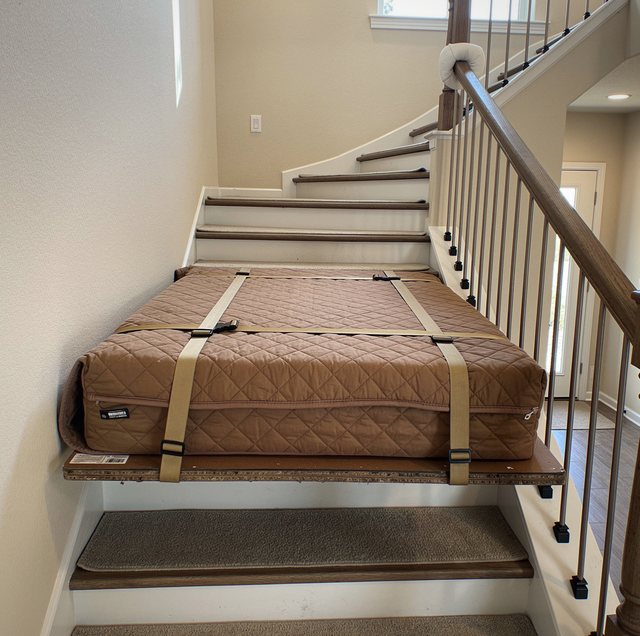
A piano on a staircase is its own job, apart from a couch or a dresser on the same steps. Its weight is concentrated in the cast frame and the action, high in the case rather than spread evenly through it, so the piece wants to tip the moment it leaves level ground. It also has to travel on a surface that tilts beneath it, step by step, with a turn or a landing partway through, and anyone standing below it is in the path of anything that gets away from the crew. Every part of the plan is designed to keep that load controlled from the moment it leaves the floor until it sets down again.
Planning a piano move starts with a short list of variables, and each one changes once the load is on a stair instead of flat ground:
| What Gets Planned | Why It Matters on a Stair |
|---|---|
| Piano type: upright or grand | Sets how the piece gets rigged and which way it travels once it leaves the floor |
| Stair width, turns and landings | Decides whether the load travels straight through or has to pivot partway, and whether it clears at all |
| Railing and walls along the run | A railing left in place can pin the load against it or block the swing room a turn needs |
| Headroom at ceiling breaks and fixtures | A piano raised onto a board or turned on its side changes its tallest point partway through the carry |
| Floor surface at the top and bottom of the run | A hard landing needs protection where the load sets down, and a soft one needs something solid under it |
| Number of people and who takes the downhill side | The downhill position takes the share of the weight that gravity pulls toward it |
| Equipment: straps, board, dolly | Matches the gear to the piano's shape and to the way it travels on the stair |
How Upright and Grand Pianos Move Differently
An upright piano stays upright for the whole trip. It is strapped to a dolly or stair hand truck over padding, with the straps holding it against the frame rather than against loose panels. On the stair, it travels one tread at a time while the case stays vertical.
A grand piano cannot travel upright at all; its width and its legs make that impossible on a stair. The legs and the lyre, the pedal assembly, are unbolted first, and the case is lowered onto a padded, rigid board sized to the piano and strapped to it. From that point, the piano and the board move as one rigid unit, on its side, controlled by the straps and the crew once it reaches the stairs.
Measuring the Route Before Anyone Touches the Piano
Before either piece leaves the floor, the crew walks the stair from the piano's starting spot to the truck and measures its width, turns, and landings, for a load that cannot be tipped and re-angled the way a smaller item can. A straight run with no turn is the simple case: the load travels the same direction the whole way, and only its width and the ceiling above it matter. A run with a landing partway down changes that, because the board or the dolly has to pivot within the landing's own footprint, and a landing too small to hold that pivot can rule that route out.
Headroom gets checked the same way, since a piece raised onto a board or turned onto its side does not have the same tallest point it had standing on the floor, and a stairwell that steps down near a turn, or a light fixture hung low over a landing, can catch a load that cleared the floor below it with room to spare. The railing gets measured too. A railing that narrows a turn can determine whether the load fits that route at all, and any railing work is settled before moving day rather than on the day.
How a Crew Controls the Load on a Stair
Once the piano is rigged, whether strapped upright to its dolly or lying flat on its board, the same principle governs the climb or the descent: the load moves one step at a time, under load-bearing straps that put the weight on shoulders and arms rather than on a grip alone, and it never moves faster than the slowest person controlling it. On a board, the piece is walked down tread by tread, kept square to the stairs and level side to side rather than tipped, so no part of the load's weight rides on a single edge or corner.
A piano on a stair can pin or crush anyone standing below it if the load starts to slide, so family, pets, and bystanders stay off the stairs and out of the landing below until the moving crew sets the piece down.
How many people the carry takes depends on the piano and the stair, and the crew sets that count on the walkthrough, with the width of the stair and the room at each turn deciding how many hands can reach the load at once.
Protecting the Stairs, Walls and the Piano
The case, the board, and the stairway itself all get padded before the load moves, not after. Moving blankets go over the piano's body and are held snug so they do not slip loose mid-carry, and corner guards go on the corners of any turn first, since those are the points a rigid board or a tall upright case meets a wall as the group pivots. The stair treads themselves get a non-slip runner or padding where the dolly's rails or the board's edge will ride, both to protect the finish underfoot and to give the crew's footing something to grip.
Where the load has to pass close to a wall on a landing, or a newel post at the foot of the stairs, that surface gets padded too, since a piece this heavy does not need much contact to leave a dent or crack plaster. None of this is optional once the piano is rigged: a scuff on a wall is a repair, but an unpadded corner catching the case mid-turn can also throw the load off balance at the moment it is pivoting.
What the Owner Prepares Before Moving Day
The route gets cleared completely before the crew arrives: rugs picked up, cords out of the way, furniture pulled back from the base of the stairs, and from any landing the piece has to turn on. Deciding the piano's exact spot in the new home ahead of time, rather than deciding it on the spot after the crew has already carried it up, keeps the piece from being set down, picked back up, and moved again once everyone is already tired from the stairs.
A floor spot for the piano away from an outside wall, a heating or cooling vent, and direct sun keeps it out of the temperature and humidity swings those three create, as the wooden soundboard swells and shrinks with them.
The other half of preparation is telling the crew about anything the walkthrough might not catch: a tread that feels loose or springs underfoot, a tight turn, or a decorative railing rather than a structural one. A piano that has just made the trip up or down a stair also needs time in its new spot to settle to the room's temperature and humidity before a tuner's work will hold; that adjustment is a separate trade the owner schedules once the piano is in place.
Frequently Asked Questions
They travel wrapped and apart from the case. On some grands, the legs are not interchangeable even though they look identical, so the crew tags each leg to its own corner before the board goes on.
No. It matters only where the railing sits in the load's path at a turn or a landing. The newel post at the base of the stairs anchors the whole railing run, so the route is planned around it as a fixed point.
Sometimes not by that stair at all. A spiral stair's center pole and continuous curve leave no straight section long enough for a rigid board to pivot through, and when the interior route will not work at all, the alternative is a hoist or crane at a window or balcony opening, which is specialist rigging arranged apart from the move.
Not quite. A piano board has no wheels of its own: across a flat floor the strapped board rides on a separate dolly, and at the stairs it comes off the dolly.
The straps never touch bare wood. They run over a layer of moving blankets or padded strap sleeves wherever they cross the case, and on a polished finish a pad goes at each point where a strap changes angle, since that bend is where friction concentrates as the load shifts against it.
No. The casters on a piano are built for small moves on a level floor, and under the piano's full weight they can snap or gouge a floor at a threshold or the lip of a step, so the piano rides on a dolly or a board instead.
Secure a specialty piano move — dolly, moving straps and corner guards for the carry, with custom padding and wrapping for the case. Timeless Moving LLC serves Katy, Cypress, Sugar Land. Call (346) 489-5383.